Introduction of Plants and Animals Introduction by Humans
The purpose of this post is to
review the introduction of plants and animals, non-native species by humans into
new region, the impact of it, whether it is advantageous or disadvantageous to
native plants and animals. Foremost, the introduction of them is not noticeable
and do not cause damage to the native species until they appear in large
quantity that is uncontrollable. Next, the introduction of plants and animals
has to concern about its successfulness, the process that lead to invasion of
exotics, the detrimental effects of exotics and the criteria that should be met
before exotics are intentionally introduced to new areas. To look the consequences
of the introduction of plants and animals, the difference impacts on island and
on the mainland are compared.
Introduction of plants and animals
which are non-native species, is a type of invasive or exotics species to the
native species. Introduced animals and plants threaten the ecology, disrupted
the food chain as well as food web, and bring some extinction to the native
species. Humans as dispersal agents have been proved to be more disadvantages
compared to the pros of it. We can see many plants and animals introduction by
humans are due to the continuous supply of food, ornament, biological control
and by accidental. Of course, the percentage covered by accident is the
smallest among all but the effect of it is very large.
In a new region, the non-native
species colonies it in a slow pathway. It is often not noticeable by the human
and when it does, it may already compete with the native species, which will
cause ecological and economic damage to the local place. This will then change
the composition of species in that region. Over a period of time, it may affect
the genetic flow of the native species.
The suitability of plants and animals
to new region much met its ecological niche and habitat. The biotic condition
such as competitor and vegetative structure must be suitable to the non-native
species, while the abiotic condition such as temperature, humidity, salinity
and substrate condition must be met to succeed in new area. Besides, adequacy
of introduction unit must accomplish these characteristics, which are
sufficient in health, behavior and simple number. Lack of resistance of red fox
in the Alligator River National Wildlife Refuge, North America to bacterial
infections, made them hard to survive. When the introduction of plant and animals
to new place, the degree of escape from disease, parasites and predators also
dependent in successfulness of the non-native species, where counteradaptation
must be met. Also, the new region give the opportunity to the non-native
species, where there is less competition, especially in islands, the
successfulness of introduction is higher.
The Factor and Effect
of Introduction of Plants and Animals by Humans
The introduction of plants into the
new region is good when the region is destroyed by the catastrophe or by
deforestation. This is because the native species need a longer time to
recover, while the non-native plants can colonise the region in shorter time as
the number of competitor is minimized and the different climate they met is
suitable for them to grow. Forest restoration can be done quickly by wise
selection of native plants or exotic species. This is to restore the soil
fertility and stabilize soil. However, the non-native species should be
gradually replaced from time to time with native trees that can promote carbon
sequestration and produce hardwood (Patrick L.O. 2012). This can be seen in the
Australia tree (Acacia spp.), along the road of UMS, they can grow at a faster
rate as well as absorbing water at a greater amount. This circumstance may
interrupt grows of native tree such as Kapur paji, Seraya kuning and Gagil. In
another country like South Africa’s largest cities in the region has a direct
effect on the runoff of watershed.
Another process for introduced animals
into new region is to control the exotic species. This can be seen in the
introduction of predator red fox to the European rabbit population in Australia
and mongooses to control rats on various oceanic islands. On the other hand,
the introduction of these predators also brings another effect to the
environment. Introduction of it is to the total reduction in viable seed by
Larinus planus will reduce the potential for recruitment and will likely lead
to a quantitative decrease in the density and persistence of this native
species in these stands over time. However, the potential side effect of biological
control is rare.
In addition to the above statement,
the African giant snail (Achatina fulica), that are previously introduced to
some island like the island of French Polynesia, Tahiti and Saipan as a source
of food. In contrary, the mass production of it has made the loss of native vegetation
and crops. The predatory Wolf Snail (Euglandia rosea), was introduced to
overcome this situation. In spite of that, the native species was the victim of
the predatory snail, especially the genera Partula and Samoana (S. attenuata),
and they are disappeared in the wild. In Hawaii, where the E. rosea has also
introduced, the condition of the subfamily Achatinellinae, is thought to be
unlikely to survive much longer in the wild (Hadfield, 1986).
Next, the introduction of water
hyacinth (Eichhornia crassipes), as an ornament or decorative item has make
Lake Victoria a mass problem and contributed to the buildup of eutrophication.
Water hyacinth is native from Southern United State of America to Argentina and
West Indies. Due to the mass production of it, the living organism under the
lake will die eventually as there is low penetration of sunlight that obstruct
the photosynthesis of plant, and low oxygen level that inhibit the respiration
of fish and other organism. It cost a lot of money to collect it to produce
fuel. Then, some scientists from South African have used the biological
control. They imported the some insects, which include two beetles, namely
Neochetina eichhorniae and Neochetina bruchi, to control the number of the
water hyacinth. These bugs are natural enemies to water hyacinth in the Amazon
Basin and feed on different parts of the plants and different ways.
For animal, the red-eared slider
turtles (Trachemys scripta
elegans), were originated from Southern United as favorite pets.
After it was banned in USA in 1975, some turtle farms turned their production
toward exportation, mainly to Europe and Asia. They get their names because
they got red patch of skin near their ears. In European, these turtles compete
with the native species, European pond turtle, Emys orbicularis for basking
site and survival, which they utilize the same habitat with greater efficiency.
The Trachemys were able to survive in most winters in western Europe and success
in breeding is the factors that outcompete the native turtles in term of
densities and space.
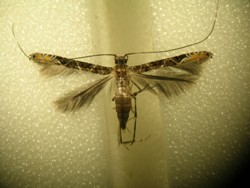
Cocoa pod borer is a serious pest to cocoa and rambutan.
Furthermore, the next incidence is
caused by accidental introduction by humans. This happened in some animals and
plants that have unintentionally been carried with ship or other forms of
transport. For example, the brown tree snake (Boiga irregularis) that carried
accompany with the shipments of fruit from Southeast Asia to Guam around 1940s
or during World War II (Rodda et al. 1992). They not only affect the
distribution of native bird but also the tree around Guam. This is due to the
fact that birds are one type of pollinator to the native tree in the area of
Guam. The dispersal of native mangrove tree, Bruguiguiera gymnorrhiza by the bird pollinators have led to a
reduced seed set and seedling recruitment.
Some native species also went to extinction due to the introduction of
brown tree snake. In contrary, the web-building spiders were becoming abundant
compared to other due to smaller number of the bird species preying on them.
In Sabah, the dandelion (Taraxacum
spp.) is believed to be brought by foreigners that climbed to Mount Kinabalu.
It was quite unnoticeable for the first few years and it was quite attractive
when it was found. Few year after the colonization of the dandelion, it was
found that it has effect on the native species, where they compete for
nutrient, water, light and space. It was found that non-native species have
better breeding systems and fecundity as well as the attractiveness that make
pollinators prone to make non-native dandelion like T. officinale reduce the
grown of T. japonicum in Japan. The introduction of dandelion has made a loss
of money, estimate about $500 million in controlling them.

Dandelion in Mt. Kinabalu.
Furthermore, the hybridization of
non-native species with the native species has brought to the extinction of the
native species and has potential for genetic swamping, where the loss of both
genetic diversity and locally adapted population, especially the rare and
threatened one. The introduction of mallard duck (Anas platyrhynchos) into New
Zealand has interbreed effectively with the native grey duck (Anas
superciliosus), that less than 5% of the combined population of these two forms
is representive of the pure grey duck(Gillespie, 1985). If this proceed, it is
unlikely for the grey duck to survive in the wild.
The hybridization of plants between the native
species and introduced species are not noticeable until they are abundance in
nature. Hybridization is the interbreeding of individuals from distinct species
or occasionally from genetically distinct population (Julie et al.). This can
bring to the concern of the conservation biology on the maintaining the genetic
flow of the small population of native species before it came to an extinction.
For example, cactus Opuntia littoralis and the introduced Opuntia ficus-indica
produce the Opuntia occidentalis in southern Carlifornia. However, these
hybrids are favored and good for the species because they occupy a less
inflammable habitat than parental species.
If compared the island with the mainland,
the invasive species will lead to the extinction of the native species as can
be seen in the introduction of the brown tree snake to Guam. According to the
Theory of Island Biogeography, at any given time, the number of species on an
island is the result of a balance between two processes, that is immigration or
colonization and extinction. The mainland have a numerous resource to discover,
when one species is decrease in number or almost diminish, the predator can
switch to other preys to eat, whereas on the island, the limitation of the
colonization can make it to eat their prey until they extinct. This situation
is very dangerous as the genetic flow will cease especially the endemic species
and the threatened one. The Galapagos Island and Madagascar has banned some trade
that halts the dispersal of invasive species to this area to prevent the
extinction of the endemic species.
Conclusion
In
conclusion, the introduction of plants and animals by human has many cons
rather than it pros. The introduction of them can make the area less resource
to use, the predation on the native species will bring to the trophic cascade,
in which top down influence affect from the predator to the nutrients absorb by
plants. There should be some considerable criteria like doing some laboratory
experiment on the effect of the introduction of plants and animals to a new
region before they are bring to another region. Moreover, the introduced form
should measure it should not have any bad impact on the native species. The impact
should, at least, has the basic ecosystem characteristics that does not disrupt
the specified or introduced region.
.JPG/220px-Mimosa_pudica_(Mimose).JPG)
Mimosa pudica
Recommendation: To read more about this, you all can refer to these books!
Recommendation: To read more about this, you all can refer to these books!
"Read more, Gains more"
George W. Cox. (1997). Conservation Biology. 2nd Edition. Wm. C. Brown. Page 202-210.
Glen MacDonald. (2003). Biogeography: Introduction to Space, Time
and Life. John Wiley and Sons. Page 368-372.
Johnathan E.M. Baillie, Craig
Hilton-Taylor, Simon N. Stuart. (2004). 2004 IUCN Red List of Threatened
SpeciesTM: A Global Species Assessment. IUCN, Gland, and Cambridge, UK.
Page 93.
Julie L. Lockwood, Martha F.
Hoopes and Michael P. Marchetti. (2007). Invasive
Ecology. Blackwell. Page 13-266.
Neil A. Campbell, Jane B. Reece. Lisa
A. Urry, Michael L. Cain, Steven A. Wasserman, Peter V. Minorsky, Robert B. Jackson.
(2009). Biology. 8th
Edition. Pearson Benjamin Cummings. Page 1233-1255.
Patrick L. Osborne. (2012). Tropical Ecosystems and Ecological Concepts.
2nd Edition. Cambridge University Press. Page 172, 182-184, 196-198,
234, 243, 308, 403-423.
Source for invasice species: Invasive species
Source for invasice species: Invasive species
If you want to find out more, please click http://www.youtube.com/watch?v=r3OATv_Yq6g and other related video.
Thank you.
Thank you.

No comments:
Post a Comment